Page 2
2. Mallee bound
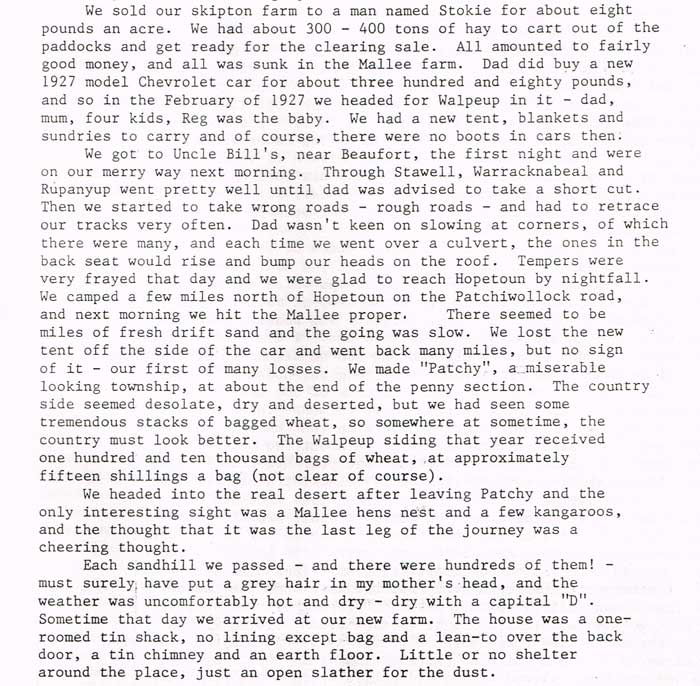
While in NSW, Alfred met his future wife, Alice Laurence, who was working as a domestic servant at A. S. Austin's Bynya homestead near Griffith in the west of the state. Alice and Alfred were married at Alice's hometown of Narrandera in 1910. As detailed in winnie's memoirs, after their marriage they first lived at Beaufort, where Laurie and his two sisters Winnie and Teen were born. In the winter of 1920 they moved onto a soldier settlement block near Skipton. Over the next six years Alfred and Alice worked hard to improve and expand the farm and its retinue of buildings and equipment. But Alfred also began to suffer from seizures thought by his doctors to stem from his accident and subsequent illness in South Africa. By the winter of 1926 the seizures had become so bad that Alfred decided they should move to warmer and drier climes. As Laurie recalls, at 'that time a land boom had come over the Mallee, and after seeing a glowing advertisement in the Ballarat Courier, dad went up and purchased a block in the land of opportunities, seven hundred and forty acres on a "walk in walk out" basis for six pounds ten shillings per acre'. His memoir continues:
 |
 |
The photo on the left was taken at Skipton in 1921 and shows (L/R): Laurie (6 years old), Winnie (10), Les (3) and Teen Cheeseman (8).
The one on the right shows Laurie and his father Alfred at Skipton in 1925. Alice had written on the back:
'Fred and Laurie going out to cut hay, note old Prince in the middle . . . Prince is 18 years old'.

The boys at Skipton primary school in 1924. Les and Laurie Cheeseman are 8th and 9th from the left in the second row.
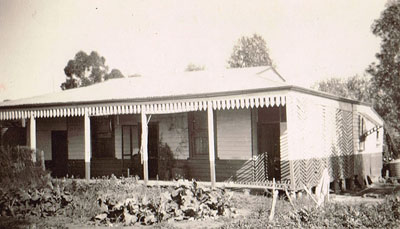
Their house at Walpeup must have been a bitter disappointment to Alice in particular. As Laurie describes: it 'was a one-roomed tin shack, no lining except bag and a lean-to over the back door, a tin chimney and an earth floor. Little or no shelter around the place, just an open slather for the dust'. Undeterred, Alfred and Alice set about making their new house more comfortable and their new block as productive and profitable as their farm at Skipton. They had the advantage of growing children to help them and money left over from the sale of their first farm. But the land was poor and, as the following extracts from Laurie's memoir illustrate, the elements much more hostile and unforgiving than at Skipton.